Will A Tempered Glass Screen Protector Really Save Your Phone?
The man at the counter presses one on in forty seconds and tells you your display is now unbreakable. It is not, and believing him is how people end up surprised.
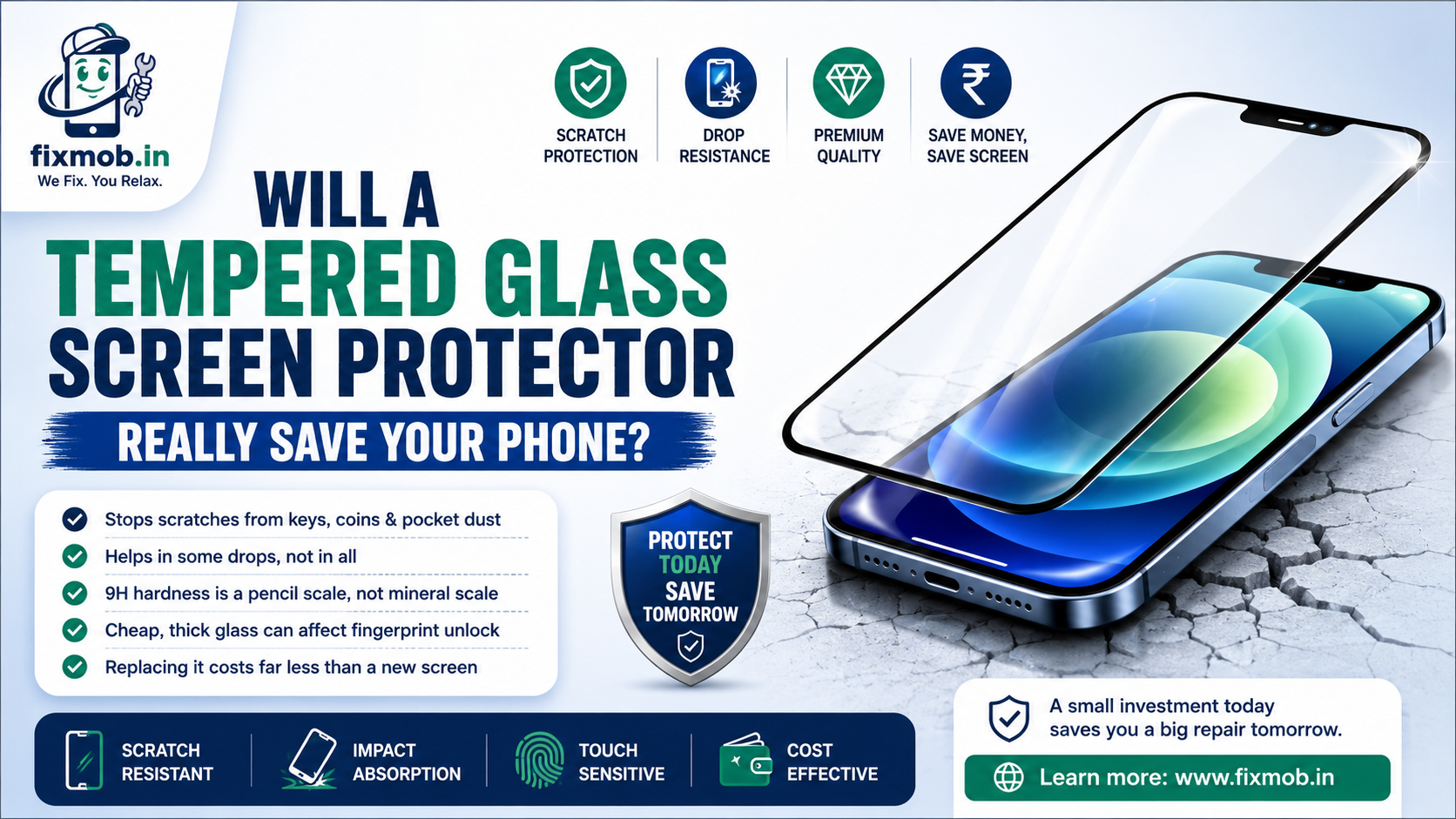
A tempered glass screen protector is very good at one job and unreliable at another. It stops the scratches that build up every day, and it helps with some falls but not the ones that actually break phones. Knowing the difference saves you money twice.
The Short Version
• Scratch protection is the real benefit, and it works reliably
• Drop protection is partial and depends entirely on how the phone lands
• The 9H number on the box is a pencil scale, not the mineral scale
• Cheap thick glass is the usual cause of fingerprint unlock failing
• Replacing the layer costs a fraction of replacing the display
What Does A Tempered Glass Screen Protector Actually Do?
It works as a sacrificial layer. Anything that would have scraped, chipped, or cracked your display hits the cheap sheet on top instead, and you throw that sheet away. A tempered glass screen protector is designed to be damaged so the panel underneath is not.
Scratches are the everyday threat, and this is where the layer earns its price. The grit in your pocket is mostly quartz sand, which sits at seven on the mineral hardness scale, while phone cover glass sits a little below it. Sand wins that contest every time.
Bengaluru makes this worse than most cities. Construction dust along the Outer Ring Road, road grit in the monsoon, and coins sharing a pocket with your handset all grind at the surface daily.
Corning, which supplies the cover glass on most flagships, describes its product as offering damage resistance to the scratches, bumps and drops of everyday use. Resistance is the operative word there. Nothing on the market is scratch proof.
• Fine scratches from sand, keys, and coins in a pocket
• Scuffs from sliding the phone face down across desks and counters
• Chips along the edge from small knocks against door handles and tables
• Surface damage that would otherwise reduce your resale price
Will It Stop Your Screen Cracking In A Drop?
Sometimes, and it depends almost entirely on how the phone lands. A flat, face down fall from pocket height onto a smooth floor is the case where a tempered glass screen protector genuinely helps, because the sheet spreads the force and often shatters instead of the display.
Corner impacts are the ones that break phones, and no protector prevents them. When a phone lands on its corner, the force travels through the frame into the display from below, so a layer sitting on the front surface never enters the equation.
Height matters as much as angle. A fall from a table behaves very differently from a fall from a moving scooter or a staircase, and past a certain point the panel breaks whatever is stuck to it.
|
How the phone lands |
Does the protector help? |
Why |
|
Flat, face down, desk height |
Usually yes |
The sheet absorbs and spreads the impact |
|
On a corner, any height |
Rarely |
Force enters through the frame, not the front |
|
Face down onto gravel or grit |
Often yes |
The sharp point hits the sacrificial layer first |
|
From above head height onto concrete |
Seldom |
Impact energy exceeds what the panel survives |
|
Bag knock or pocket pressure |
Usually yes |
Spreads point pressure across a wider area |
Treat the layer as insurance against the cheap accidents, not the expensive ones. A case with a raised lip does far more for corner protection than any front sheet, which is why the two belong together rather than as alternatives.
Our guide on why cracked screen repair should not wait covers what happens once the panel itself goes.
Tempered Glass Or Plastic Film: Which One Should You Buy?
For most people, glass. A tempered glass screen protector scratches far less than plastic film, feels like the original surface under the thumb, and does something for impact where film does nothing. The exception is a curved or folding display, where film conforms to the shape and glass will not.
Deciding between the options for tempered glass for phone screen protection comes down to your handset shape, your sensor type, and how much you care about the feel of the surface.
|
Type |
Scratch protection |
Impact help |
Best for |
Watch out for |
|
Standard tempered glass |
Strong |
Partial |
Flat screens, most phones |
Edge lifting inside a tight case |
|
Full cover glass with black border |
Strong |
Partial |
Phones with slim bezels |
Poor cutout alignment on copies |
|
PET or TPU film |
Weak |
Minimal |
Curved and folding displays |
Scratches within weeks |
|
Matte or anti glare glass |
Strong |
Partial |
Outdoor use and gaming |
Slight loss of display sharpness |
|
UV adhesive glass |
Strong |
Partial |
Heavily curved edges |
Glue seeping into ports if fitted badly |
|
Privacy glass |
Strong |
Partial |
Commuters and shared offices |
Noticeably dimmer at an angle |
One warning about UV adhesive types. They are fitted with liquid glue that cures under a lamp, and a careless application lets that glue run into the earpiece slot or the charging port, which turns a cheap accessory into a repair bill.
Why Does A Cheap Protector Break Your Fingerprint Unlock?
Because the sensor has to read your finger through the extra layer, and thickness or air gaps get in the way. In display sensors are the ones affected, and a badly made tempered glass screen protector is the single most common cause of unlock failing days after a new sheet goes on.
Ultrasonic sensors, used on several Samsung flagships, are the fussiest. They read ridges using sound, so any trapped air bubble between the glass and the display scatters the signal.
Optical sensors, which are more common on mid range Android phones, cope better but still struggle with thick or tinted sheets. If unlock started failing the same week you changed the layer, you have your answer without opening anything, and our guide to fingerprint unlock not working explains how to re enrol properly afterwards.
• Buy a sheet labelled as compatible with your sensor type, not just your model
• Re enrol your fingerprints after fitting rather than adding one more
• Reject any sheet that leaves a visible bubble over the sensor area
• Avoid stacking a new layer on top of an old one
What Should You Check Before You Buy One?
Six things, and none of them take long at the counter. Fit matters most, because a sheet cut for a similar model sits crooked, lifts at the edges, and blocks a sensor.
Buying a tempered glass screen protector for the wrong variant of your handset is the mistake people make most often, and the box rarely makes the difference obvious.
Ignore the 9H marketing figure while you are at it. That number comes from a pencil hardness scale used for coatings, and it says nothing useful about whether sand will scratch the sheet.
1. The exact model and variant. A Pro and a Pro Max take different cutouts, and so do regional variants of the same phone.
2. Sensor compatibility. Check it names your fingerprint sensor type if your phone has one under the display.
3. Thickness around 0.3 mm. Thicker sheets feel clumsy and interfere with unlock more often.
4. An oleophobic coating. Without it the surface smears constantly and never wipes clean.
5. Case friendly edges. A sheet that runs to the very edge will lift where the case presses on it.
6. Fitting included. A dust speck under the glass is permanent, so let someone with a clean setup and an alignment frame do it.
Fit it in a bathroom after a hot shower if you are doing it yourself. The damp air pulls dust out of the room, which is an old trick and a genuinely effective one.
Is It Cheaper Than Replacing The Display?
By a very wide margin, and this is the whole argument. A protector costs a few hundred rupees and takes ten minutes to swap. A phone screen replacement in Bangalore runs into thousands on a mid range handset and considerably more on a flagship with a bonded panel.
Replacing a cracked sheet a few times a year still costs less than one display job, so the arithmetic favours the layer even if you are clumsy.
There is a resale angle too. A phone with an unmarked original display holds its value noticeably better than one with a scratched panel, and buyers in the second hand market check the screen before anything else.
What the two options actually involve:
• Replacing the protector. A few hundred rupees, ten minutes, no parts come out of the phone
• Replacing the display. A workshop job with adhesive, sensors to transfer, and a warranty to check
• Ignoring a cracked panel. Touch failures, dust ingress, and a bigger bill later
If your display is already damaged, a new sheet on top will not fix it, and it hides the crack rather than stopping it spreading. You can see what a proper repair covers on the doorstep screen repair services page.
Frequently Asked Questions
Is tempered glass worth it for a budget phone?
Yes, arguably more than for a flagship. Budget displays are cheaper to replace but still cost a large share of the handset’s value, so the protection ratio is much the same.
Can I put a new protector over a cracked screen?
Only as a temporary safety measure to hold loose glass in place. It does nothing to stop the crack spreading, and any technician will remove it before working on the panel.
How often should a tempered glass screen protector be replaced?
Whenever it chips, cracks, or starts lifting at a corner. Most people get six to twelve months out of one, and a shattered sheet has already done its job.
Does a screen protector affect touch sensitivity?
A well fitted tempered glass screen protector of around 0.3 mm does not. Thick sheets, trapped bubbles, and cheap adhesive do, usually as dead spots near the edges.
Will it survive a fall from a moving vehicle?
Almost certainly not. That impact energy is far beyond what any front layer manages, and the frame and rear panel usually take damage as well.
Does fitting one void my phone warranty?
No. It is a removable accessory that never touches the internals, unlike an unauthorised repair, which can affect your cover.
Ready To Protect Your Screen?
Buy the sheet cut for your exact model, check it names your sensor type, and have it fitted by someone with an alignment frame and a clean bench. That is most of the value of a tempered glass screen protector, and it costs very little.
If the panel underneath is already cracked, chipped, or dropping touch response, a new layer only hides the problem. Book a doorstep repair slot and have a technician look at the display before the damage spreads further.